-

- 07 July 2026
- Comment (0)
Belgium dominates, scores four goals to end World Cup run for U.S.
SEATTLE – The Americans were left shaking their heads.
This one was hard to believe.
It wasn't so much what Belgium accomplished, it was what the U.S. men's national team failed to accomplish. The Americans started flat and slowly, falling behind early and, eventually, falling short, making too many costly mistakes in critcal moments.
In the end, Belgium advanced to the quarterfinals of the FIFA World Cup with a 4-1 victory, kocking the U.S. out of the tournament and silencing the soldout crowd of 66,925 at Seattle Stadum.
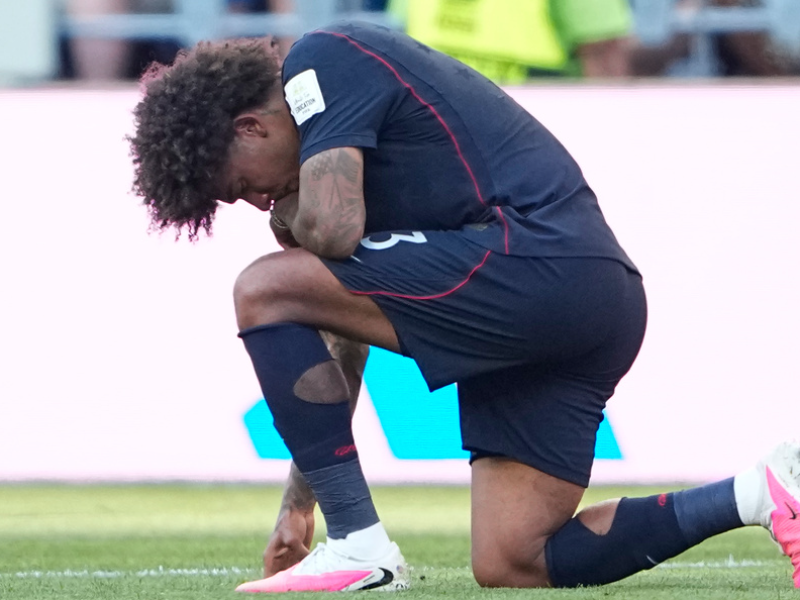
U.S. midfielder Tyler Adams covered his face with his jersey. Defender Chris Richards dropped to the grass in disbelief. Fans watched the score board stunned.
"Yes it stings," Adams said. "I don't like to be eliminated from anything. Tonight was not a good performance overall. It's not what we looked to achieve. There was a lot of things we could have done better."
The U.S. must now wait another four years before another World Cup presents an opportunity to prove to the millions of international football fans that the Americans are a challenging side.
And who knows when FIFA will return to this country. The U.S., Canada and Mexico hosted the 48-team event, attracting football fans from around the world. The tournament finals will be held in East Rutherford, N.J., on July 19 at the Medowlands.
But for the Americans, the tournament is over.
U.S. coach Mauricio Pochettino, who became the U.S. national team's all-time winningest manager in World Cup history, must now face the question about whether he plans to stay with the national team. And the national team must face the questions about how it plans to improve its quality of play on an international stage. Coaches and players may return to the team's new headquarters in Atlanta and contemplate the future.
The rest of us are left to ask the tough questions and start the uncomortable conversations.
"I don't think the conversation should die down," U.S. defender Tim Ream said. "How incredible this journey has been with this group? How can we keep the conversation going? How can those boys and girls continue ... how can we continue to inspire them now that the tournament is over? It was a secondary things for us, but we fully aware of what and how we were inspiring the rest of the country."
After outplaying Bosnia and Herzogvina to advance to the Round of 32, the U.S. team entered the match with Belgium looking to prove it possessed the quality to play with a high-ranking FIFA squad and advance to the quarterfinal round – a place it hadn't been since 2002. With this type of statement victory, the men's national team could point to significant growth since the country last hosted the World Cup in 1994.
"I think that was the goal was to obviously inspire people that the sport was growing in the U.S.," Adams said. "I think we saw. The support was unbelievable. I think our initial reaction as a team was that in this moment we let them down. But altogether people gravitated towards the team because we were relatable.
"We represented exactly what the U.S. was. Today wasn't a good day."
With a new 48-team format introduced at this year's World Cup, many observers believed the actual tournament started with the Round of 32. The U.S. cruised through the three-game Group Stage, winning group D with victories over Paraguay and Australia.
Many dismissed a loss to Turkey in the third game, suggesting that a complete roster shift accounted for the debacle. They received a pass.
A 2-0 victory over Bosnia and Herzogvina soothed the minds of American well-wishers and somewhat satisfied naysayers, who pointed to the match with Belgium as the true test for an American team led by striker Christian Pulisic.
He owns the most caps on the team and retuned for this match after recovering from a leg injury suffered in the tournament's opening game.
Pulisic was joined up top by American forward Folarin Balogun, who had received a red card in the previous game and by tournament rules was suspended against The Red Devils.
Until he wasn't.
FIFA announced that its displinary committee had upheld the referee's red card decision but ruled to allow Balogun, who in recieving the penalty had landed on a player's ankle as he tried to bring his foot to the ground, to return to play for the match against Belgium.
Instead of keeping out of the match, the committee applied Article 27 of the FIFA Disciplinary Code, which allowed the one-match penalty to be be suspended for a probationary period of one year.
"It's important for me to say that it was totally unintentional," Balogun said prior to the match with Belgium. "The choice of the referee ... I don't think it was the correct call. I think a yellow card would have been fair."
Belgium appealed the decision, but didn't need the help. This match was decided on the pitch and it didn't go the American's way for much of the evening.
The match, hosted on July 7, 2026, saw Belgium's Charles De Ketelaere shine, scoring in the 9th and 33rd minutes, playing pivotal roles early on.
The U.S.'s response came swiftly as Malik Tillman equalized in the 31st minute, drawing the score 1-1, but it was not enough as Belgium soon regained the lead.
Tillman scored for the second game in row on a free kick. Balogun was fouled outside of the box to set up the free kick. Tillman launched a dart that skipped off a Belgium player's head into the goal.
Hans Vanaken extended Belgium's advantage in the 57th minute, cementing the team's control.
Despite the American's greater ball possession, maintaining 56 percent, they struggled to convert opportunities, managing just two shots on target from seven attempts.
Belgium, conversely, was clinical, with six shots on target out of fourteen.
The U.S. offense was stifled by Belgium’s solid defense and timely substitutions, including the introduction of Romelu Lukaku, who sealed the victory with his 90th international goal in the 90th-minute goal.
Ultimately, Belgium’s efficiency in front of goal and decisive actions in pivotal moments firmly set its place in the tournament's next phase.
The U.S. was marred by fouls, incurring two yellow cards to Weston McKennie and Malik Tillman.
Pochettino replaced Pulisic in the 59th minute after he injured his leg. The striker, who leads the team in caps, attempted to continue but was replaced by forward Sebastian Berhalter.
Pulisic sat on the bench holding his head. His teammates continued to possess the ball yet could not find the back of the net.
For the Americans, who drew large rambunctious crowds and delivered an exicting brand of football at times, all of the beautiful World Cup moments will be remembered by historians.
Meanwhile, the ugly truth of elimination will continue to sting into the coming weeks.
"It's tough to judge right now. The overall tournament after a loss," Adams said. "I think overall there were positives that we'll take from it, just not now."
About the Game
Welcome to the world of the FIFA World Cup, a global football tournament. Football, also known as soccer in some countries, is a team sport played by two teams of 11 players each on an outdoor field.
The main goal is to score more goals than the opposing team. A goal is scored when the ball is kicked into the opposing team's large net, called the goal.
Games last 90 minutes, divided into two halves of 45 minutes each, with a short break in between called halftime. Players use their feet to kick the ball, but they can also use their heads or other parts of the body, except their hands and arms.
Only the goalkeeper, who stays near the goal to try to stop shots, can use hands within a specific area called the penalty box. Some important terms you'll hear include "offside," which is when a player is in an illegal position closer to the opponent's goal than the ball and the second last opponent, and "fouls," which are rule violations leading to free kicks or penalty kicks, depending on where they occur.
The FIFA World Cup occurs every four years and is considered the most prestigious football competition in the world. In 2026, teams from around the globe compete for the title.
The tournament is structured with a group stage followed by knockout rounds. Initially, teams are divided into groups and each team plays against the others in its group.
Teams earn points for each match: three points for a win, one for a draw, and none for a loss. The best teams advance to the knockout stage, where they compete in direct elimination matches until only one team remains as the champion.
The World Cup is exciting because it brings nations together in a celebration of culture and sport, showcasing the best talents and fostering international camaraderie.
Understanding these basics helps you follow the matches and enjoy the thrilling spectacle of the world’s most-watched sporting event.