-

- 12 March 2026
- Comment (0)
Cloud Infrastructure Is Too Centralized to Be Safe
The Web2 era of the internet has taught us that concentrating power in the hands of a few big tech players doesn’t end well. Outsized power over culture, commerce and Capitol Hill rarely moves society forward.
Yet consecutive outages at Amazon Web Services (AWS) and Microsoft Azure have led to major disruptions online and across financial systems, hospitals and airlines—impacting millions of people globally.
These incidents highlight one undeniable truth: the cloud, as we know it, is breakable. It’s breakable because it’s centralized. A few major players control the infrastructure that society runs on. That concentration is not only unstable, it increasingly represents a national security risk.
A 15-hour AWS outage reported in October 2025 was traced back to an issue at one of Amazon’s data centers. Approximately 1,000 websites and web services that rely on AWS for storage, hosting or databases were affected. Experts say incidents like this are unlikely to remain isolated events. Without structural changes to how cloud infrastructure operates, disruptions will likely become more common as demand grows.
Decentralizing Compute
Argentum AI Founder and CEO Andrew Sobko says the moment should serve as a wake-up call for policymakers and the private sector to confront what is at stake if the current infrastructure model remains unchanged.
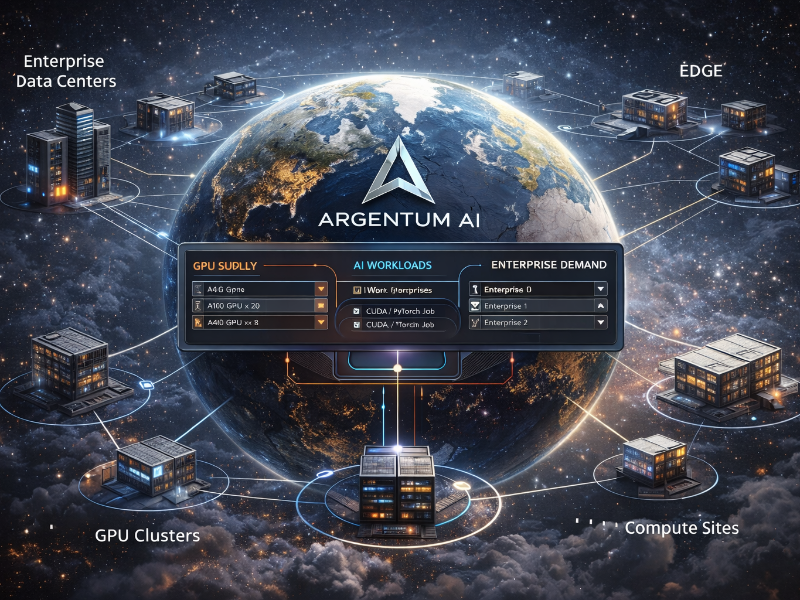
Argentum AI is an open, enterprise-level, AI-powered compute marketplace designed to make compute liquid, verifiable and globally accessible.
Sobko’s experience building marketplaces comes from the supply-chain world, where the core challenge is matching supply and demand under real-world constraints: location, reliability, compliance and time.
“When AI hit, I saw the same pattern but worse: compute supply is fragmented, underutilized, and locked inside a few gatekeepers, while demand is exploding. The ‘aha’ moment was realizing the shortage wasn’t only about manufacturing more GPUs—it was about unlocking the massive amount of idle and second-life capacity already out there and making it enterprise-trustworthy,” he said.
The marketplace connects buyers—enterprises and AI teams that need compute—with providers such as data centers, neo-clouds and enterprises that have GPU capacity available.
Buyers submit workloads with constraints including GPU type, timeline, budget, region, latency, sovereignty and compliance needs. The platform then matches those workloads with the best-fit supply based on price, performance, reliability and jurisdiction—not simply the cheapest GPU hour.
It’s important to note that the cloud becoming centralized was partly a necessity. Economies of scale, reliability demands and operating complexity historically favored large providers capable of building and maintaining global infrastructure.
However, that same model now concentrates risk.
Today the industry faces systemic outages, security concentration and geopolitical vulnerabilities that must be addressed.
“One failure can cascade across airlines, banking, health systems and emergency services,” Sobko explained. “Access can be constrained by sanctions, policy shifts or jurisdictional conflict. A small number of targets become ‘crown jewels’ for attackers.”
Those risks only increase in the AI era.
We need infrastructure that is resilient by design—multi-provider, distributed, verifiable and capable of graceful failover. Infrastructure must also offer transparent pricing and open access so compute power is not controlled by a small number of monopolies.
So why do we accept extreme centralization in digital infrastructure in ways we would never accept for food, water or energy?
Sobko believes the answer is simple: digital infrastructure scaled faster than public understanding of its implications. The same could be said about AI today.
“For payments and fintech, a small number of processors and cloud dependencies can freeze millions of transactions. For healthcare systems, centralized EHR and cloud dependencies can halt clinical workflows,” he warns.
It is also worth noting the irony that cryptocurrency platform Coinbase went down during a previous AWS outage. Even exchanges promoting decentralized finance often rely on centralized infrastructure behind the scenes.
What remains uncertain is how emerging infrastructure models will function at scale.
Is decentralized compute still proof-of-concept, or is it a viable alternative to hyperscale cloud providers? Where might this idealistic vision fall short?
Time will tell.