-
- 12 June 2026
- Comment (0)
Community Partners Bring Behavioral Health Support Closer to Baltimore Youth
May was Mental Health Awareness Month, but for Baltimore families, the need for behavioral health support extends beyond one month. Community-based organizations are showing that trusted neighborhood spaces can help young people and families connect with care.
CareFirst BlueCross BlueShield is highlighting the impact of its $8 million, three-year investment in 19 community-based organizations across the region. In Baltimore, three grantees—Chase Brexton Health Care, Enoch Pratt Free Library and the Pride Center of Maryland—are using that support to expand access and meet people where they are.
CareFirst said the decision to invest in community organizations came from recognizing that barriers to behavioral health care often begin outside a doctor’s office. “We knew going in that a lot of the biggest barriers to behavioral health care don’t start in a doctor’s office,” CareFirst BlueCross BlueShield stated. “They show up in schools, at home, or in communities where access has historically been limited.”
Through the investment, CareFirst supported programs that help people connect to services, receive support in familiar settings, and benefit from a behavioral health workforce that reflects the communities it serves. The organization said it measures success through screenings, referrals, programs and workforce development.
At Chase Brexton Health Care, the grant helped launch a patient navigator model designed to connect families to coordinated medical and behavioral health services. The model screened 2,920 youth for behavioral health needs. Of those, 770 were identified as having unmet needs, 760 were referred to behavioral health services and 145 engaged in care.
The numbers point to progress and continuing challenges. A referral alone does not always mean a young person can begin treatment. Families may face transportation issues, scheduling conflicts, stigma, insurance questions or uncertainty about how to navigate the system. Patient navigators help close those gaps by guiding families through next steps after referral.
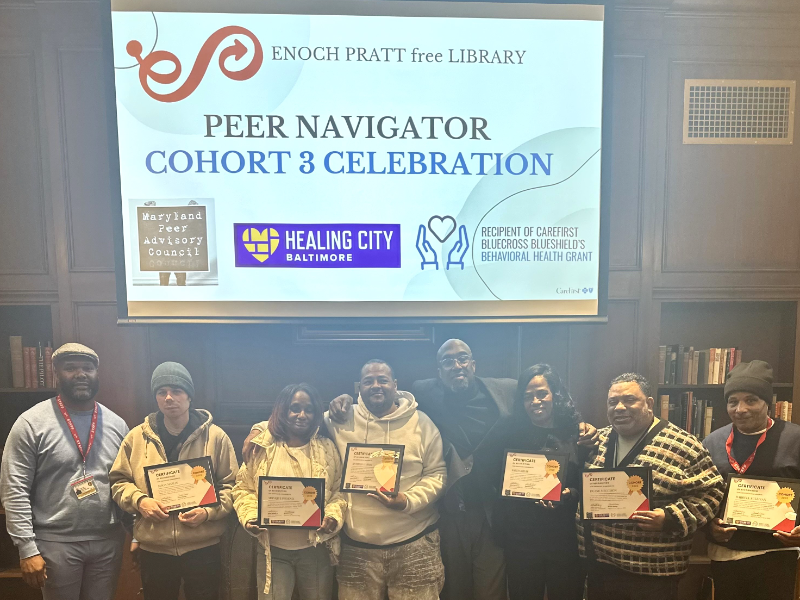
The Enoch Pratt Free Library, in partnership with the Maryland Peer Advisory Council and Healing City Baltimore, used its grant to launch a peer navigator workforce development program. Peer Recovery Specialist Interns completed more than 3,600 hours of training and provided nearly 10,000 hours of direct service in library branches.
For Tara Bhardvaj, a project manager within the library, one of the biggest surprises was how quickly community members trusted the program. “You expect that it will take time for people to establish trust in a very vulnerable moment,” Bhardvaj said. “And that’s what this program provided, a safe space.”
She also noted the strength of word of mouth. People came into branches asking for specific peers by name after hearing what those peers had done for friends, relatives or neighbors.
Derrick George, Registered Peer Supervisor for Outreach and Mobile Services, said libraries are well suited for this work because they are community hubs. “These days we have to meet people where they are,” George said. “A lot of people, for many reasons, maybe can’t or won’t get out and go to a mental health facility.”
By embedding support inside library branches, the program made it possible to address needs immediately in a setting residents already use for information, technology, programs and connection.
The Pride Center of Maryland launched its Well-being and Behavioral Health Project to support LGBTQ+ and same-gender-loving youth through affirming mental health and wellness programming. The center reported that youth developed greater confidence in navigating their mental health, improved emotional regulation skills and a greater willingness to access mental health care.
Cleo Manago, Chief Executive Officer of the Pride Center of Maryland, said many LGBTQ+ and same-gender-loving young people carry burdens created by rejection, bullying, discrimination, family conflict and unsafe environments.
“PCOM’s Well-being and Behavioral Health Project was created to provide something different,” Manago said. “We believe affirming care begins by recognizing the dignity, value, and humanity of every young person who walks through our doors.”
As the three-year grant period concludes, CareFirst said sustainability depends on strengthening partnerships, helping organizations document their impact and supporting models that can attract future funding. The library program will continue with opioid restitution funding from the city.
CareFirst said the most replicable lessons are to begin with trusted community partners, bring behavioral health support into familiar places and treat access and workforce development as connected challenges.
For Baltimore youth and families, the work shows that care can begin in a clinic, a library branch, a community center, or any trusted space where someone is ready to listen.