-

- 12 June 2026
- Comment (0)
What Really Feeds Your Soul
June is Soul Food Month. And those three words conjure something different in every person who hears them. For many in the Black community, they bring a vivid, warm image: a plate piled high with fried chicken, candied yams, collard greens, cornbread, mac and cheese — the kind of meal that meant celebration, comfort, and belonging. The kind of meal that felt like love.
But what happens when that love starts robbing you — not just of your health, but of your time?
That is the question at the heart of Daphne Joseph's story. Daphne is my administrative assistant, my virtual right hand, the person who keeps the engine of my wellness brand running. But she is also, quietly and powerfully, someone in the middle of a transformation — and her journey deserves to be told out loud.
Four out of five African American women are overweight or living with obesity. That statistic is not abstract. It has a face. It has a story. And sometimes, it has a cheesing-from-ear-to-ear grin, because the story is changing.
The Image in Her Head
When I asked Daphne what comes to mind when she hears the phrase "soul food," she didn't hesitate. "A nice plate of Caribbean food," she said. "Brown stew chicken, baked mac, yams, some cabbage. All that. And it looks lovely in my mind."
Then I asked her how that image compares to what would have come to mind a year and a half ago.
"The image would be the same," she said. "But the difference is what I'm going to do with that image."
That single sentence stopped me. Because she's right: the transformation isn't about erasing the plate in your mind. It's about what you decide to do once it's there.
A year and a half ago, Daphne told me, the image of that plate would have led her straight to the kitchen — or the restaurant — to get exactly that, plus extra mac and cheese. Today, she can hold the image, appreciate its warmth, and let it live in her memory rather than her body. "Mac and cheese doesn't serve me in the way I wish to be served by the food I consume today," she said. She hasn't had it in a long time. And she's made her peace with that.
The Hidden Cost: Food That Steals Time
There is something in Daphne's story that I want every reader to pause on — something that doesn't get talked about nearly enough in conversations about food and health.
Food that doesn't nourish you doesn't just affect your health. It steals your time.
"It doesn't feel good to realize you're losing hours in your day because of what you're eating," Daphne told me, with the kind of clarity that only comes from having lived through it. She described the familiar post-meal crash — the food coma that keeps you horizontal when you meant to be moving, thinking, creating, living. "And to be able to get that back — that's everything."
Think about the math: if two meals a day leave you too sluggish to function, and you live that way for twenty years — how much of your life has been spent lying down on a couch you didn't choose to be on? How much creativity, productivity, joy, and presence has the wrong food taken from you? That time cannot be bought back. But it can be reclaimed — and that is exactly what Daphne is doing.
How the Journey Began — By Accident
We started working together by accident. Daphne came into my world through a professional connection — she was learning what I do as a food story coach and wellness educator. In that conversation, something happened. She heard herself in my story. "I'm hearing rawness I've never heard before," she recalled, "notes of a story that sounds like mine that I've never heard before." Words were exchanged. Something unlocked. And she went home and walked her block.
"That was just my day one to this beautiful transformation," she said.
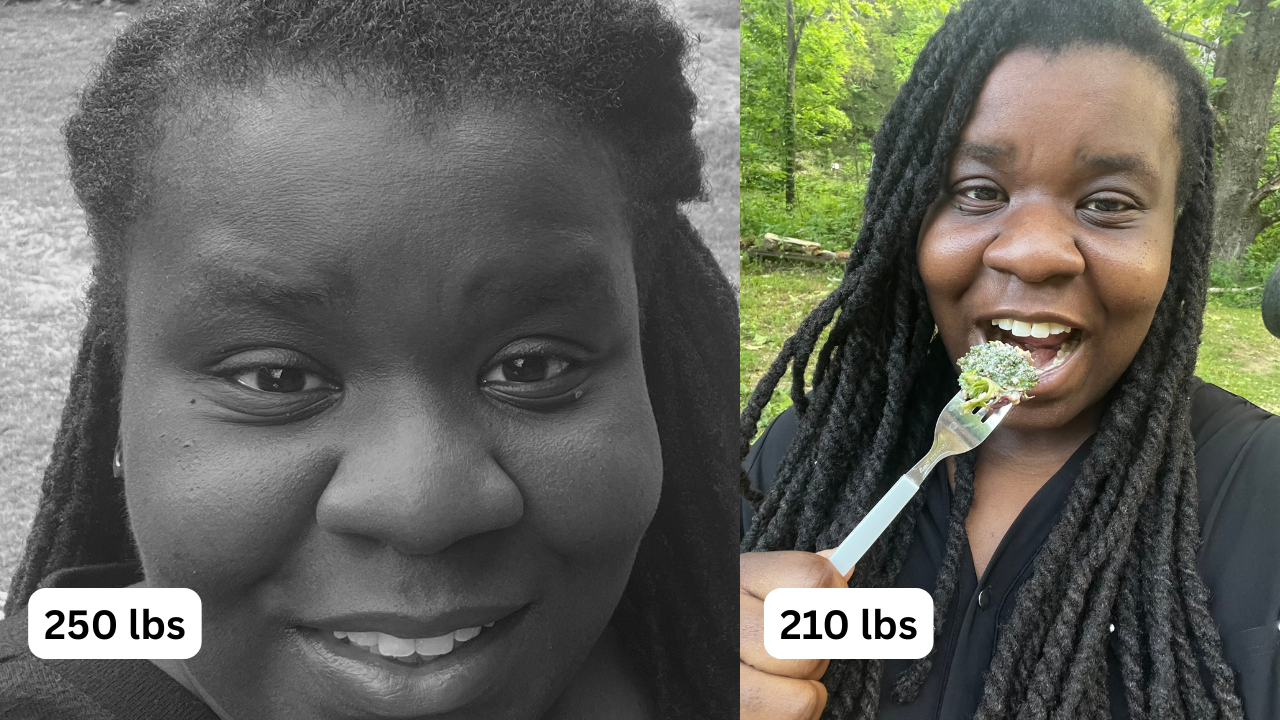
Daphne started at over 250 pounds. Before she ever officially joined my program, simply by being immersed in the content — moderating events, managing the brand, absorbing the philosophy — she began to shift. She addressed a long-standing binge eating pattern. "I was the type to go get a bunch of food and eat so much, I had to lay down," she said plainly. "No way I could walk around afterwards." Healing that alone, before anything else, was a major milestone.
When she officially entered the program, she knew immediately that her first act of commitment had to extend beyond food. She quit smoking — something she had struggled with privately her entire adult life, something very few people knew. She shared it with two people she trusted in her personal life. They judged her. Hard.
"It hurt," she said. "People I cared about."
But inside the group — a community of women in the program — she found something different: a container of honesty and zero judgment. That space, she said, was massive. And it reminded her of something she had come to understand this was never just about food. It was always about the whole person.
The Writing That Set Her Free
A cornerstone of the program is prescriptive writing — and for Daphne, it became the key that opened doors she had long kept shut.
"The writing helped me address the trauma I was hiding," she said. "Holding on to, even past the confusion. I lived in confusion for a really long time." Once the writing gave her a way to face what she had been carrying, something shifted. Headspace cleared. And into that cleared space, she could finally begin absorbing — really absorbing — what it means to nourish a body.
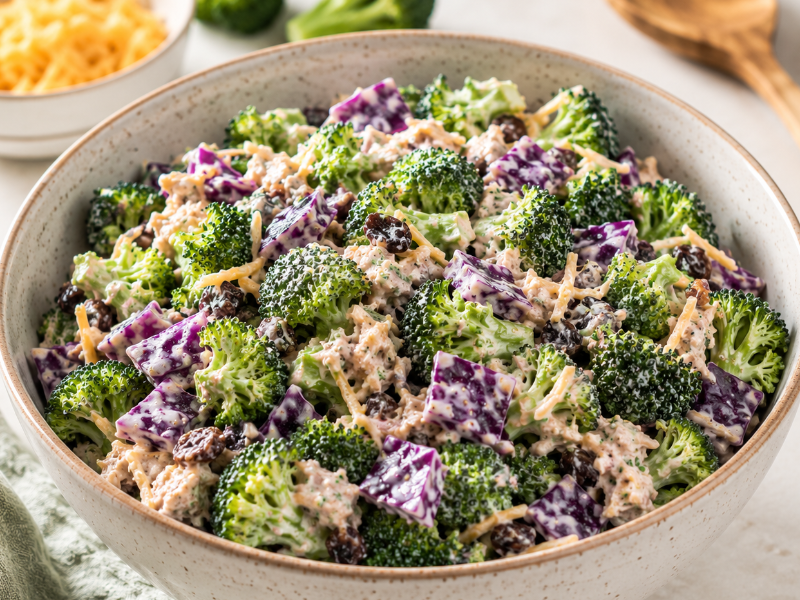
Now, in her thirteenth month in the program, she is back in her kitchen — cooking again with creativity and intention. She recently made a broccoli salad and shared it with the women in the group. "I know that's not traditionally soul food," she said, smiling, "but it could be. It was extremely hearty. I could see sitting around with my friends, enjoying that, still talking about what you put in that — the flavors, the spice profile. I could have the same conversations I'd have at a table full of food I don't want in my body."
What she is calling for — and I believe she is right — is a mass redefining of soul food itself. What if soul food was simply food that made your soul feel good? Food you come out of feeling amazing, not food that puts you to sleep. Food that brings people together in joy and keeps them present — fully present — at the table.
A One-Way Journey
The path from over 250 pounds to 209.8 pounds was not a straight line down. Daphne is the first to say so, and she says it without apology. There were plateaus. There were moments of going back to processed food and feeling her body reject it with unmistakable force. There were months where the scale didn't move because she was doing the deeper work — the mental and emotional excavation that had to happen first.
"Because this is a one-way transformation," she said. "I'm allowed to give myself time to address things one at a time. That's why it hasn't been a straight line — but that's also why today, it's not a fight."
She has lived through therapists — mostly forced on her before age eighteen — and systems that she felt, in her words, "almost seemed like nobody wanted me to get out." She came into this program carrying decades of unprocessed pain alongside patterns of food and other addictions that were all coping mechanisms for the same buried wound. What she found, finally, was a framework and a community that wanted her whole.
And near the close of our conversation, she offered something I want to leave with every reader — particularly every Black woman who has been told, in one way or another, that she does not have value:
"Once you realize you have worth, once you realize you have value, some people will refuse to treat you with that value. You can't bring them with you. There is so much noise out there — family, friends, social media, commercials, ads — all of it telling us to dishonor our bodies. Not caring about our intrinsic being. I don't have all the answers. I just am starting to get the awareness."
Awareness. That is where it starts. Not with a diet. Not with a number. With the recognition that what truly feeds your soul is not always what's on the plate.
What Soul Food Can Become
This Soul Food Month, I am asking you to expand the definition. Let soul food be anything that nourishes your body, honors your history, and still lets you show up fully in your life. It can be that broccoli salad Daphne made — the one with enough flavor and heartiness that you'd talk about at a table of friends just as passionately as you'd talk about mac and cheese.
What we eat and how we eat are conversations about who we believe we are — and who we believe we deserve to be. Daphne Joseph, grinning from ear to ear at 209.8 pounds, has decided who she is. She is someone worthy of her own nourishment. Someone who is getting her time back. Someone on a one-way journey.
And she is just getting started.