-

- 20 April 2026
- Comment (0)
Inside DataVault’s Rapid Rise: Nate Bradley on Turning Data Into a Measurable Asset Class
DataVault has moved from early-stage infrastructure into a company approaching multi-billion valuation territory within a compressed period. Its growth places it at the center of a shift in how data is understood, priced, and exchanged.
In a recent interview, co-founder Nate Bradley described a system designed to convert data from an operational burden into a structured financial asset. The implications extend across enterprise balance sheets and into national economic systems.

Bradley’s entry into this space did not begin in finance. He previously founded AudioEye, a digital accessibility company that builds infrastructure enabling people with disabilities to navigate online systems. That experience established a framework for addressing structural gaps through technology while maintaining commercial scale.
“When I started DataVault, I was looking to have social impact equivalent to what I did at AudioEye,” Bradley said.
DataVault, operating as DataVault AI Inc., builds on that foundation with a model that treats data as an asset that can be valued, scored, and monetized. The company integrates artificial intelligence, blockchain infrastructure, and financial exchange systems to create a market layer where data is no longer static.
“We did what Zillow did to real estate,” Bradley said. “We did that to data.”
The company’s framework introduces what functions as a credit system for data. Datasets are evaluated based on completeness, ownership rights, and usability, then assigned a financial value that can be acted upon across markets.
“We added a layer of valuation and score,” Bradley said. “So you can look at a server or a phone and know how much data is on it in terms of dollar value.”
The system operates across three mechanisms that define its architecture. Data is indexed regardless of how it enters an organization. It is assigned value based on production cost and demand. It is scored to determine quality and rights before entering exchange environments.
“Our clients can use DataVault to look at their data in its value, score it, and then ultimately turn it to cash,” Bradley said.
This model aligns with broader structural changes across the global economy. The International Data Corporation projects the global datasphere will reach 175 zettabytes, while McKinsey & Company reports that data-driven organizations significantly outperform peers in operating margins. Despite that scale, most companies still lack a system to directly price data.
DataVault positions itself within that gap by operating as an indexing and valuation layer rather than a storage or processing platform.
“We never take custody of the data,” Bradley said. “We simply do a white glove appraisal of it.”
That distinction matters in a market defined by risk. According to IBM’s Cost of a Data Breach Report , the global average breach cost has reached $4.45 million. By evaluating data in place rather than duplicating it, DataVault reduces exposure while preserving ownership.
“We believe AI should be subordinated by human beings,” Bradley said.
That perspective aligns with global policy direction. The OECD AI Principles emphasize human-centered systems that maintain accountability as automation expands.
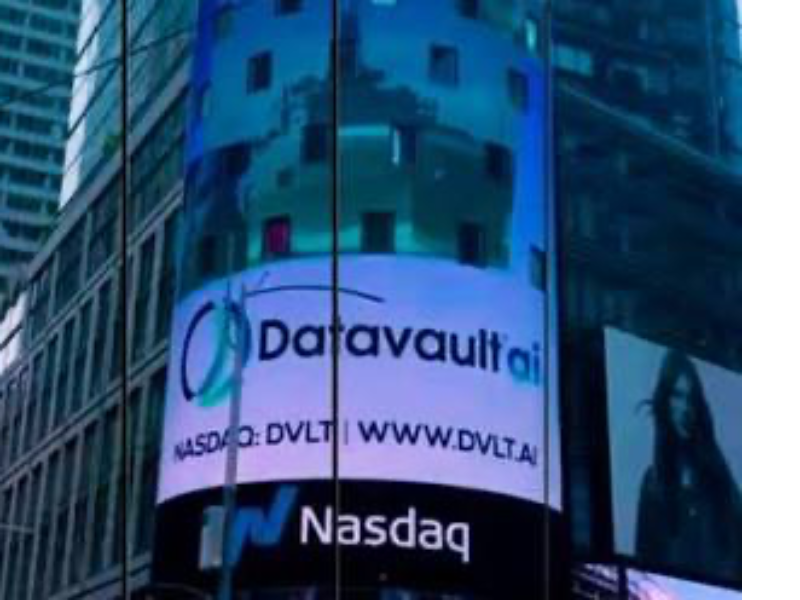
DataVault’s model extends beyond enterprise systems into financial infrastructure. The company is building tokenized exchanges connected to markets, including systems aligned with NASDAQ.
“We’re building a token exchange that rides on the most trusted infrastructure ever, the NASDAQ,” Bradley said.
The company’s acceleration is tied to its position within real-world asset tokenization. Deloitte research and Boston Consulting Group projections identify this as a multi-trillion-dollar market opportunity.
“Less than 10 percent of real-world assets could eliminate national debt,” Bradley said.
The company is also expanding globally through initiatives tied to digital economies, including collaborations with the Mandela family aimed at enabling countries to enter Web3 systems.
“We’re putting the technology on top of countries to help them enter the Web3 ecosystem,” Bradley said.
That expansion reflects a broader thesis that data ownership can generate new forms of economic participation. DataVault’s system allows individuals and organizations to monetize data tied to identity, performance, and lived experience.
“If we can convert data into a cash asset, it becomes a renewable source of revenue,” Bradley said.
The company’s valuation growth reflects increasing institutional interest in this model. DataVault has moved from a $9 million valuation to hundreds of millions within a short period, with projections pointing toward multi-billion scale as adoption expands. Every organization produces data, yet few have infrastructure to measure or monetize it.
“We take a cost center and turn it into a revenue generating asset,” Bradley said.
The next phase of development centers on automation within the data economy, where artificial intelligence systems transact directly with one another.
“AI will go out with a budget and buy the data that you need,” Bradley said.
That shift introduces a market where data is continuously valued and exchanged as a financial instrument within an AI-driven economy. Ownership shifts toward those who generate the data rather than the platforms that aggregate it.
“It’s a big responsibility and an opportunity beyond belief,” Bradley said.
DataVault is building a system that treats data as measurable, tradable, and owned, establishing a financial structure around information that has historically existed without one.