-

- 06 July 2026
- Comment (0)
When Food Becomes Medicine: Roseline Ifidon's Story of Survival, Service, and a Plate That Healed Her
For most of her career, Roseline Ifidon spent her days making sure other people had what they needed. As a regional director with Work Opportunities Unlimited, she oversaw more than 450 clients across central Maryland, helping people find jobs and meet their dreams — while working a second full-time job at Catholic Charities because she loved people too much to walk away. What she didn’t make time for was herself.
“I just ate anything that came my way, anything I could see,” Ifidon recalls. “I drank soda. I was always so thirsty for sweet things. I used to eat chocolate for breakfast.” Too busy to slow down, she told herself there would be time later to think about her health.
Then, in 2017, her body forced the issue. Ifidon suffered the first of two strokes; the second followed in 2019. That year, doctors also discovered a brain tumor, along with heart disease and kidney disease. She had to relearn how to walk and talk. She had to retire early. And in the chaos of managing a body in crisis, she became something she never expected: food-insecure.
“I wasn’t driving, so I wasn’t moving around,” she said. Even after she regained some mobility, cooking was out of reach. “I didn’t want to start eating pasta or bread, or putting too much salt in my meals, because of my heart. But I didn’t even know what I should buy.”
It was a health counselor in Minnesota — taking nearly a week to research Ifidon’s situation — who found the answer: Movable Feast, a Baltimore nonprofit that delivers medically tailored meals to people living with chronic and serious illness. A registered dietitian designed meals around Ifidon’s specific conditions, down to soft-chew portions when a hernia made swallowing difficult, and her allergies to pineapple and avocado. A driver brought the food to her door every week, carrying the bags into her kitchen because she couldn’t.
“I thought it would just be one of those things,” she said of her first delivery. “But it tasted so delicious.”
This is the heart of the Food is Medicine movement, a growing field reshaping how Americans understand the relationship between what we eat and how we heal — through medically tailored meals, medically tailored groceries, and produce prescriptions written the same way a doctor writes for medication.
Organizations and platforms like WANDA (Women Advancing Nutrition, Dietetics, and Agriculture) are celebrating a decade of empowering Black women as healers and innovators. Through projects like the NOURISH Maternal Food as Medicine initiative, they highlight how indigenous and diasporic foods can be used for cultural and holistic healing.
I encountered this movement up close in May at the Food as Medicine Summit in Chicago and went deeper last month in June at FIMCON, the new national Food is Medicine Conference in Washington, D.C., where Ifidon and I met. Hearing her speak, I knew I needed her story in this space.
For Black communities, where rates of obesity, hypertension, diabetes, and heart disease run highest, this conversation matters in a particular way. We’ve long celebrated food as the language of love, gathering and survival — soul food, in the truest sense. But Ifidon’s story pushes us toward something more: food not only as comfort, but as treatment. Not instead of soul, but alongside it. Medically tailored meals are one important piece of a complex puzzle, and Ifidon is proof of what’s possible when nutrition, healthcare and human dignity finally align.
The results were measurable. Ifidon lost 128 pounds. Her hospital visits and ER trips, once constant, dropped sharply. Her medical bills came down. “Whatever it is that we put in our mouths really helps us,” she said. “Food is not here to hurt us. It’s here to cure us.”
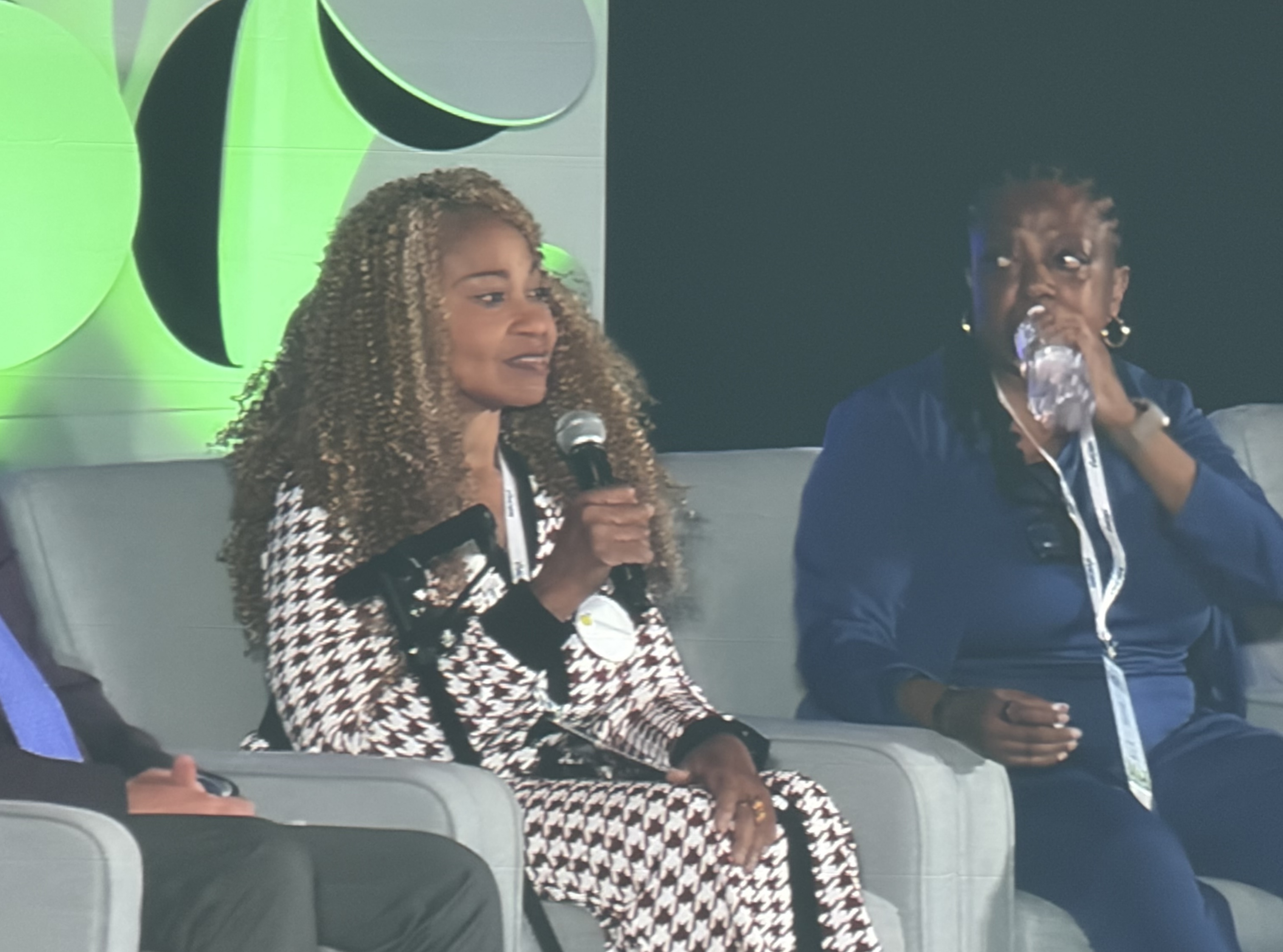
Ifidon Speaking at the June 2026 Food is Medicine Conference in Washington, DC. FIMCON
Today, Ifidon serves on Movable Feast’s Community Advisory Board and governance committee and speaks nationally as an unofficial ambassador for Food is Medicine — including for the Food is Medicine Coalition and the Rockefeller Foundation. Her advocacy now centers on one goal: making Medicare and Medicaid coverage for food is medicine programs permanent, even as funding faces new uncertainty. She recently joined a Hill Day visit to the Capitol to make her case directly to lawmakers.
Networks such as Black Women in Food actively fight for equity and representation. They ensure that Black women are not just preparing meals but are leading as business owners, investors, and policymakers in the evolving food space.
“Health is wealth,” she said, echoing her grandmother’s words. “But you have to look at what you’re consuming to get to that point.”
As we reflect on the dishes that raised us and look beyond Soul Food Month, Ifidon’s journey asks us to hold two truths at once: our food carries our culture, and it can also carry our cure.
Ready to start eating healthy? Get my exclusive How to Start Eating and Shopping Healthy workbook here. https://go.michellepetties.
Michelle Petties is a TEDx speaker, Food Story coach, and the award-winning author of the memoir Leaving Large: The Stories of a Food Addict. After gaining and losing 700 pounds, Michelle discovered the secret to overcoming stress and emotional overeating. Her free workbook, Mind Over Meals, reveals her core principles for losing weight and keeping it off.